



Want to Subscribe?
Read Corporate India and add to your Business Intelligence

 Unlock Unlimited Access

Published: January 31, 2024
Updated: January 31, 2024
The persistent attacks by Iran-backed Houthi rebels, who control large parts of Yemen, on cargo ships transiting through the Red Sea have sent shock waves through the spines of Indian businessmen in general and exporters as well as importers in particular. As these Houthi militants are attacking vessels in the Red Sea with missiles, citing the shipping companies’ connections with Israel, it is sparking serious concerns over maritime safety and disruptions in shipping routes, and inflicting an adverse impact on Indian maritime trade and commerce.
After all, the Red Sea is one of the most relied-upon export routes for India as it is the primary route for shipping to Europe, the US east coast, the Middle East and Africa. As around 80 per cent of India’s merchandise trade with Europe passes through the Red Sea and substantial trade with the US also takes this route, both geographies account for 34 per cent of India’s total exports. The Red Sea strait is vital for 30 per cent of global container traffic and 12 per cent of world trade.
In the wake of the war between Israel and Hamas, India is being targeted as it has friendly relations with Israel, and the Houthis are bent upon attacking Indian ships. This is bound to administer a body blow to India’s efforts to raise its export business. During the last two months, these attacks on Indian ships have impacted India’s exports considerably.
According to an initial assessment conducted by the Research and Information System for Developing Countries, a New Delhi-based think tank, the Houthi attacks have led to a 6.7 per cent drop in Indian exports. Based on the last fiscal year’s total exports of $ 451 billion, this would work out to around $ 30 billion for the current fiscal year as exporters now prefer to hold back shipments due to rising fears.
Providing these estimates, Sachin Chaturvedi, director-general of the think tank, told Bloomberg, “The crisis in the Red Sea will indeed impact India’s trade and may led to further contraction in exports.” His fears are not far-fetched. After all, the Red Sea-Suez Canal route carries 12 per cent of global trade and 20 per cent of India’s $ 1.1 trillion merchandise trade. It is the fastest sea route connecting India with Europe, the US east coast and some West Asian and North African countries. Again, it is the main route for India’s imports of crude oil from Russia.
According to Ajay Sahai, director-general of the Federation of Indian Export Organisations (FIEO), the rising threats by the Houthis has prompted Indian exporters to hold back on around 25 per cent of their cargo ships transitioning through the Red Sea route. India usually exports a variety of goods, including petroleum products, cereals and chemicals, using the Red Sea route. Exports in the current fiscal year are already flagging, with a 6.5 per cent contraction in the April-November 2023 period as compared to the corresponding period a year ago.
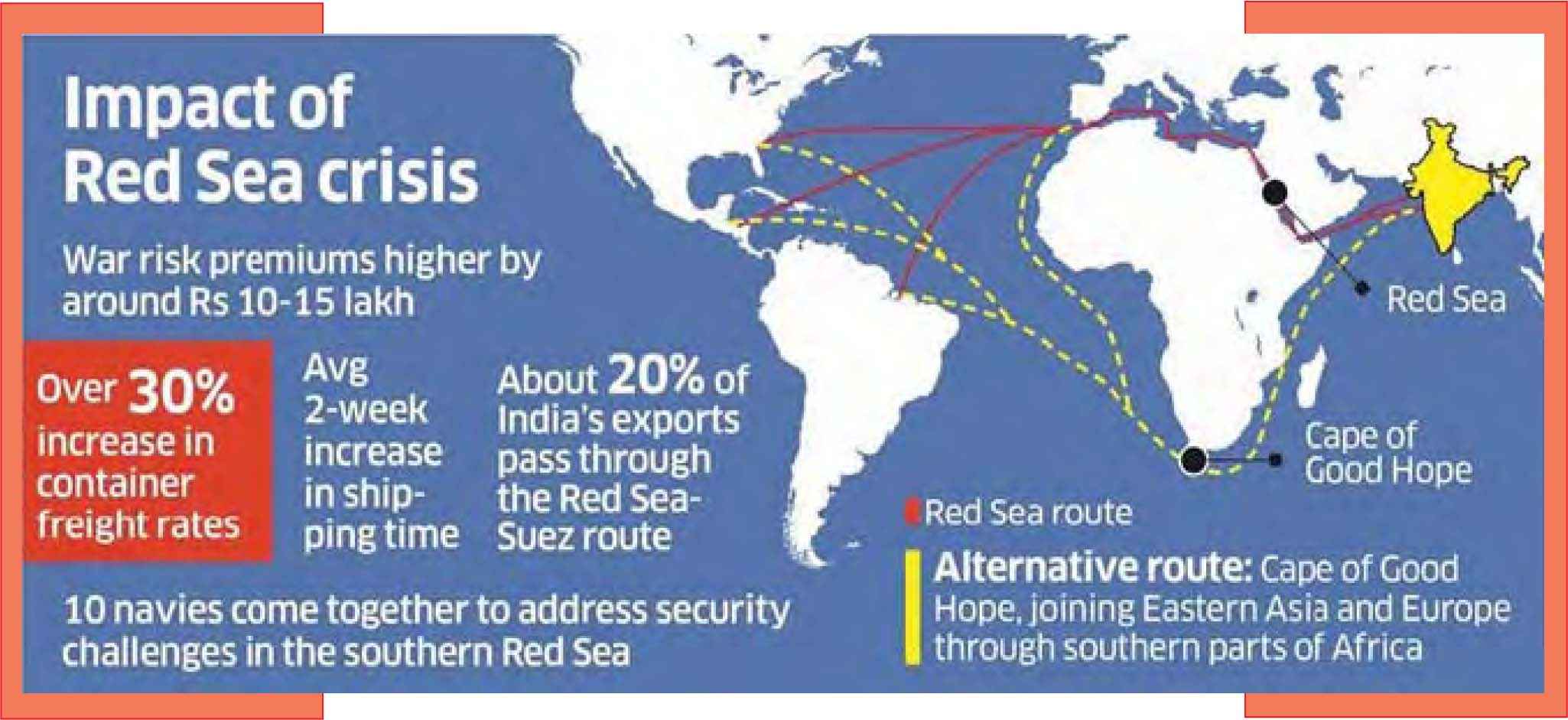
The Red Sea attacks have led to other problems for Indian exporters, who now have to grapple with a perfect storm of skyrocketing container prices, extended transit times and growing uncertainties.
With container costs surging by up to 400 per cent and routes diverted around Africa, Indian exports face a double whammy of loss of competitiveness and logistical nightmares. Exporters are struggling to absorb these dramatic increases while importers have to contend with rising costs of imported goods, potentially leading to inflationary pressures and reduced consumer demand.
Container shipping costs have witnessed a dramatic surge of as much as 400 per cent, depending on the destination, forcing exporters to either absorb the additional cost or potentially lose competitiveness. Exporters have highlighted the significant rise in freight charges, with rates jumping from $ 250 to 1,500 on some Middle East routes and from $ 700 to $ 2,500 for Europe.
Elaborating on the impact on India’s trade, Ajay Shrivastava, an expert and head of a research group focused on trade technology and climate change, says, “The conflict has increased shipping costs by 40-60 per cent. Rates for shipping a 20-ft container to Europe and the US have risen sharply, from an average of $ 500 before crisis to $ 2,000. Freight rates to ship a container to Saudi Arabia have doubled from $ 700 to $ 1,500. Indian shipments to Saudi Arabia, Yemen, and Egypt, which are geographically closer, have dramatically increased costs, given the longer shipping routes needed.”
According to him, Export Credit Guarantee Corporation of India, the government’s insurance agency for exporters, might need to cover additional shipping costs for goods currently under transit, if exporters have insured through them.
According to him, increased transportation costs will make Indian chemicals, plastics and petrochemicals expensive in European markets. These low-value but high-volume products are exported at thin profit margins, making it difficult for firms to adjust for extra shipping costs. Highvalue, low-volume and high-margin items like diamonds, jewellery and medicines can be shipped by air. At the same time, export of Basmati rice may be impacted due to quality degradation from longer transit times and higher freight costs. The delays are causing textiles and manufactured goods buyers to opt for air cargo, especially for seasonal fashion items, to avoid missing sales opportunities over late delivery. Indian exporters are holding back almost a quarter of their consignments that require transit via Red Sea. Shipping urgency is now based on buyers’ inventory levels.
Indian factories making electronics, cars and machines rely on parts from Europe, Korea, Japan and elsewhere. If one part is delayed, the whole factory might have to stop production. This is because everything needs to be in place to build a car. Long shipping delays can mess up India’s factories and the global trade system, reducing trade significantly.
Iraq, Saudi Arabia, UAE and Kuwait supply 55% of India’s crude oil imports. This will remain unaffected as they can use obstruction-free Persian Gulf and some Red Sea routes for supplies to India. However, supplies from Russia, which supplies one-third of India’s crude oil, will be severely impacted as they rely on the conflicted Suez Canal route.
A worried Indian exporter laments, “While overseas buyers are not ready to increase the price and not ready to share higher freights, movement of cargo has slowed down and cargo rates for non-Red Sea destinations have also started going up because of fewer ships available.”
Comments another exporter, “The overall logistics cost has reched an alarming level at present. The Drewry Global Index has gone up by over $ 1000 in the past few weeks since the crisis began. On some of the routes, the freight increase is as high as 300-400 per cent. Besides, shipping lines have imposed a Red Sea contingency surcharge ranging between $ 1,500 and $ 3000, apart from a peak season surcharge of $ 1,500.
Rice exporters have been severely impacted. Laments one rice exporter, “If we look particularly at the Middle East container costs have seen tremendous fluctuations. In the melee, the payment cycle has increased to three times, resulting in low purchasing power and low circulation of money.”
Unfortunately, the alternatives are also very costly. “Rerouting to bypass the Red Sea also pushes up costs and transit times significantly, raising the landed cost of imported goods,” points out a leading importer. He adds, “Ocean freight prices have surged by 56 per cent due to increased fuel surcharges, insurance costs and adjustments like GRI or RRI implemented by shipping liners. The voyage distance has been extended by 3,200 nautical miles, resulting in higher fuel consumption and operational costs.”
A leading shipping agent opines, “Economists have stated that the costs are going to increase by 60 per cent, and for imports too, as ship transit is affected both ways, due to which the cost of material will increase. Naturally, when the cost will increase, demand will go down.”
As a result, the combined effect of higher container prices and longer transit times is making Indian exports less competitive in the global market.
Exporters are urging the government to intervene at a global level to ensure the safety of shipping routes and bring normalcy back to the industry. But the government has apparently not given any serious thought to the issue and has not yet released any official estimate on the impact of the Red Sea crisis on Indian exports. This is a serious issue and urgent steps are needed to save the competitiveness of Indian exports. Otherwise, the pace of economic growth of the country itself will slow down.
August 31, 2026 - Second Issue

Industry Review


VOL XVII - 12
August 16-31, 2026
Want to Subscribe?
Read Corporate India and add to your Business Intelligence
Unlock Unlimited Access
Lighter Vein

1 Year *
Subscription
Rs 1800 /-
3 Year *
Subscription
Rs 5000 /-
5 Year *
Subscription
Rs 8000 /-
5
International
Subscription
$ 99.99
Read Corporate India and add to your Business Intelligence
Popular Stories

A modern-day enigma and a ramification of humanity's never-ending advancements, e-waste refers to the scum con- cealed by the outward glow of ever-advancing technology.
Archives


Office Address
Unit No. 405, 4th floor, Madhu Industrial Park, Avadh Narayan Tiwari Marg, Mogra Village Road, Andheri (East), Mumbai – 400069.
Call/Whatsapp
If you are interested in advertising with Corporate India, please don't hesitate to contact us. Our team is here to assist you with the process and answer any questions you may have. We look forward to the opportunity to work with you and help your business reach its full potential.
Fill out the form below to subscribe to our newsletter and never miss an update