



Want to Subscribe?
Read Corporate India and add to your Business Intelligence

 Unlock Unlimited Access

Published: September 30, 2025
Updated: September 30, 2025
Dev Pulp Pvt Ltd, a kraft paper manufacturer, was set up by the Gupta family in Meerut in 1990 with an initial installed capacity of 12,000 mtpa. The company, later renamed Dev Priya Industries Pvt Ltd (DPIPL), today has two stateof-the-art machines, a capacity of 2 lakh mtpa, and is acknowledged as among the best in the industry.
DPIPL meets 65-70 per cent of its raw material (waste paper) requirements through imports. The management remains vigilant on waste paper procurement in terms of both price and delivery schedules, as delivery schedules can be volatile due to widespread geopolitical tensions. This is important so as to ensure uninterrupted and economical supplies. The company has created a niche for itself by producing a wide range of superior quality kraft paper with absolute consistency and no adulteration. As a result, DPIPL has been able to earn a very good name in the market. Moreover, the promoter family’s high integrity and deep commitment have played a pivotal role in attracting and retaining customers, despite the volatility of the business cycle.
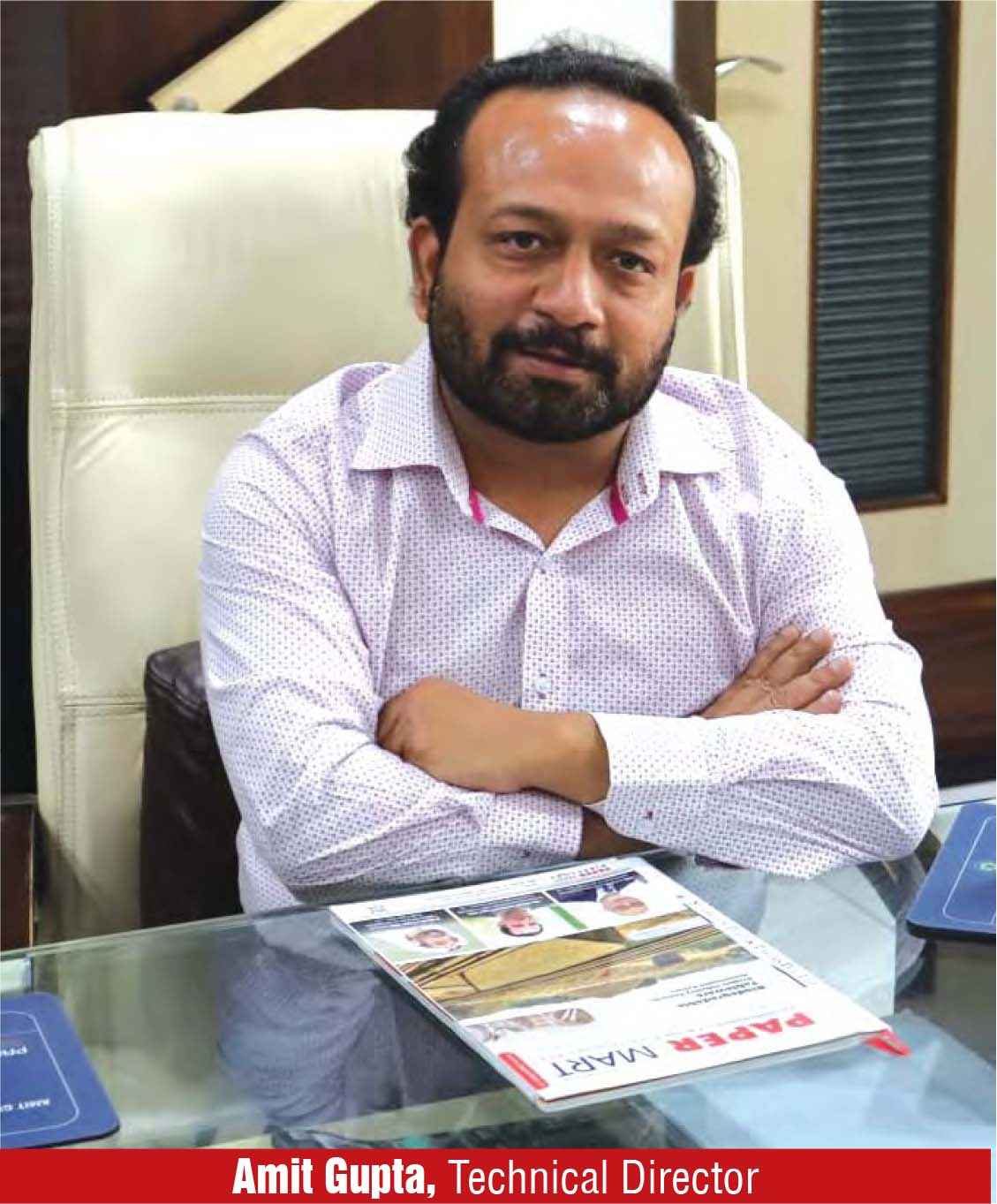
DPIPL has developed a wide bouquet of products, including fluting paper, testliner paper, recycled kraft liner and board paper. The industries it caters to include FMCG, TV and refrigerator manufacturers, food & beverages, pharmaceuticals, e-commerce, and home appliances. Its biggest strength is technical soundness. The company’s Technical Director, Amit Gupta, who has in-depth knowledge of the paper industry, explains, “We are up-to-date in every aspect of production, and are ahead of many of our competitors. This helps us in cost control and more efficiency in bringing out the final product.”
Adds Mr Gupta, “We have installed hi-tech shoe presses and a vacuum turbo on both our machines. Shoe presses provide quantitative benefits as they bring higher efficiency in paper drying. Simultaneously, we have also renovated all minor and major parts of the pulp and paper machines. Due to this, we started getting an excellent and seamless performance.”
In order to curb plastics waste, the company has set up a plastic management plant wherein plastic residuals from the production process are cleaned, dried and bunched into small beads, which are then utilised for various purposes.
Noting the stability in selling prices in recent times, Mr Gupta says, “For the first time since 2020, kraft paper prices have remained steady for more than three consecutive months. In my opinion, this has boosted the confidence of players. Of course, the ongoing geopolitical turbulence in general and the tariff war initiated by the US in particular, are potential challenges for raw material (waste paper) prices. Still, I would consider the stable selling price as a favourable indicator.”
On the near-term demand outlook, Mr Gupta says, “With the festive season round the corner, a gradual uptick will be there. But I personally feel that the rationalisation of GST rates is bound to reduce the cost of consumer durables and white goods, and will fuel greater demand. This particular factor could change the market dynamics for kraft paper. However, irrespective of this positive indicator, in my opinion our industry players should also focus on cost control, quality improvement and wider offerings, and try to penetrate new markets wherever possible.”
Commenting on the long-term outlook for kraft paper in India, Mr Gupta says, “The Indian kraft paper market is poised for significant growth, projected at a CAGR of roughly 7-9% between 2030-2033, driven by rising ecommerce and demand for sustainable packaging and luxury goods. Despite facing price fluctuations, over-production and import pressure, it shows strong potential due to government support for eco-friendly packaging and increasing consumer preference for green materials. The construction and home décor sectors also offer new opportunities for kraft paper, particularly with the demand for laminate flooring.”
On the issue of improvement in capacity utilisation, Mr Gupta notes, “If the earlier-mentioned factors fructify, undoubtedly the average capacity utilisation per unit will go up gradually to largely benefit players in the field.”
The company is coming up with a complete new upgraded effluent treatment plant (ETP) to process the effluent generated during the process of biogas production. Importantly, after further purification, it will be converted into compressed bio gas (CBG). The planned biogas capacity is estimated to be 12-14k m3/day which can be used in boiler or will be purified to produce 6 tons CBG per day. The arrangements have been made to supply this to GAIL Ltd. All these initiatives are taken eventually to augment the usage of green energy in the total energy mix.
Apart from Dev Priya Industries, another family group company, Dev Priya Papers Pvt Ltd, was established in 1988 with its manufacturing unit also located at Meerut. The company is a leading player in coated duplex board, produced totally from recycled waste paper. This board is widely used in making book covers, boxes for FMCG, etc. The major varieties being produced are Galaxy Grey Back, Elite Grey Back and Elite White Back.
August 31, 2026 - Second Issue

Industry Review


VOL XVII - 12
August 16-31, 2026
Want to Subscribe?
Read Corporate India and add to your Business Intelligence
Unlock Unlimited Access
Lighter Vein

1 Year *
Subscription
Rs 1800 /-
3 Year *
Subscription
Rs 5000 /-
5 Year *
Subscription
Rs 8000 /-
5
International
Subscription
$ 99.99
Read Corporate India and add to your Business Intelligence
Popular Stories

A modern-day enigma and a ramification of humanity's never-ending advancements, e-waste refers to the scum con- cealed by the outward glow of ever-advancing technology.
Archives


Office Address
Unit No. 405, 4th floor, Madhu Industrial Park, Avadh Narayan Tiwari Marg, Mogra Village Road, Andheri (East), Mumbai – 400069.
Call/Whatsapp
If you are interested in advertising with Corporate India, please don't hesitate to contact us. Our team is here to assist you with the process and answer any questions you may have. We look forward to the opportunity to work with you and help your business reach its full potential.
Fill out the form below to subscribe to our newsletter and never miss an update