


Want to Subscribe?
Read Corporate India and add to your Business Intelligence

 Unlock Unlimited Access

Published: August 31, 2026
Updated: August 31, 2026
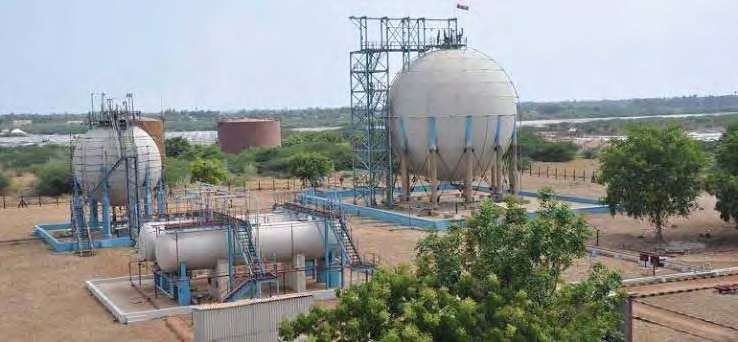
Established in 1939 and based at Mumbai, NSE-BSE listed DCW Ltd (erstwhile Dharangadhra Chemical Works) set up India’s first soda ash plant in Gujarat. Since then, the company has created a strong presence in the chlor alkali, synthetic rutile and PVC business segments. Another manufacturing plant is located at Sahupuram near Tuticorin in Tamil Nadu, spread over a huge plot of 2,900 acres.
The product basket is broadly divided into three categories – basic chemicals covering soda ash, caustic soda and poly vinyl chloride (PVC), speciality chemicals including synthetic iron oxide pigments (SIOP) and chlorinated poly vinyl chloride (C-PVC), and an intermediate category covering synthetic rutile (SR), liquid chlorine, hydrochloric acid, trichloroethylene, utox, ferric chloride, sodium hypochlorite, sodium bicarbonate and ammonium bicarbonate.

Bakul Jain, Chairman & Managing Director
Recently, the company announced a strategic investment programme of approximately Rs 250 crore, marking the first phase of its next growth cycle which will focus on expanding SIOP capacity, introducing new value-added pigment products and strengthening captive power infrastructure at its Sahupuram manufacturing complex. Plans are in place to increase SIOP capacity by 50%, from approximately 30,000 tonnes per annum to 45,000 tonnes per annum, through a phased expansion. The investment follows record SIOP sales volume in FY26, with the business operating at full capacity, and is expected to support further growth across domestic and international markets.
The expansion is supported by a sizeable global market and diversified end-use demand. The industry estimates the global iron oxide pigments market at approximately $2.5-2.7 billion in 2025, projected to reach approximately $3.9 billion by 2033, representing a 4.6% CAGR. Asia-Pacific is the largest regional market, accounting for approximately 41.5% of global revenue as of 2025.
Iron oxide pigments are widely used across construction materials, paints and coatings, plastic and other industrial applications, providing a broad underlying demand base. These are also established end markets for DCW’s SIOP portfolio, which serves applications including construction, paints, paper, laminates, packaging, furniture, plastics and rubber.
The programme is based on the company’s multi-year shift towards higher-value chemicals. Over FYs 21-25, the speciality chemicals segment registered a 26% CAGR, while the FY25 speciality chemicals EBITDA was 1.9x FY21 levels. Over the last five years, speciality chemicals have become the major contributor to the company’s profitability, providing a more resilient earnings base against swings in basic chemicals. It enters this investment cycle with a likely stronger balance sheet, as perceived by the management, which would turn net cash positive at the exit of FY27, before any additional leverage for the proposed capex.
Alongside increasing capacity, the company plans to introduce newer, value-added pigment grades, broadening its product portfolio and improving its ability to address higher-value applications and additional customer requirements. The management had previously indicated that product development in SIOP would increasingly focus on value-added grades alongside volume growth.
The company will also invest in captive power infrastructure at Sahupuram to improve energy efficiency and strengthen the cost competitiveness of both its basic and speciality chemicals business. This builds on DCW’s existing renewable energy investments.
Explaining the proposed expansion project, Saatvik Jain, President, said, “Over the last few years, we have strengthened our balance sheet, scaled speciality chemicals and improved operating efficiency. Speciality chemicals are now a major contributor to profitability, providing a stronger base for our next phase of growth. The Rs 250 crore investment plan is focused on areas where we see clear opportunities to scale. With SIOP operating at high utilisation, an established customer base and growing end-market demand, the expansion will increase capacity while moving us further into value-added pigment products.”
In another recent development, the company has elevated Sudarshan Ganapathy as Chief Executive Officer from Chief Operating Officer. He holds a Master’s degree in chemistry and an MMS in Marketing and has been with the company since 1990, with more than four decades of experience in the Indian chemical industry.
During FY26, the company registered operational revenue of Rs 2,143.6 crore, EBITDA of Rs 221.6 crore, PBT of Rs 74.6 crore and PAT of Rs 48.2 crore, translating into EPS of Rs 1.63 on equity capital of Rs 59 crore with Rs 2 face value. The book value per share and promoter group’s holding are Rs 36.43 and 45.59% respectively. Long-term and short-term borrowings have been reduced Y-o-Y at Rs 88.1 crore and Rs 187.7 crore vis-à-vis Rs 217.6 crore and Rs 208.1 crore in FY25. Needless to say, the management has not revealed the source of financing Rs 250 crore towards the phase-1 of their proposed expansion of the SIOP project.
As regards Q1FY27, the operational revenue of Rs 542 crore registered 14% Y-o-Y increase driven by 38% growth in the speciality chemical segments and 5% growth in basic chemicals. Sequentially, revenue declined by 11% due to higher captive PVC consumption for CPVC, lower PVC production, and inventory liquidation in the synthetic rutile business during Q4 FY26. The PAT margin of 6.37% and positive diluted EPS of Rs 1.17 for the period is only due to the usage of deferred tax adjustment of Rs 34.28 crore, otherwise PBT was just at Rs 35.69 lakh on equity capital of Rs 59.03 crore. Speciality chemicals EBITDA grew 19.2% Y-o-Y, supported by higher CPVC volumes following successful commissioning of the recent capacity expansion.
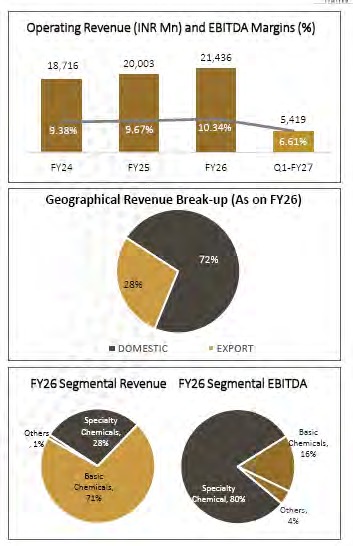
OPERATING REVENUE & EBITDA MARGIN TREND
| Metrics | FY24 | FY25 | FY26 | Q1 FY27 |
|---|---|---|---|---|
| Operating Revenue (Rs mn) | 18,716 | 20,003 | 21,436 | 5,419 |
| EBITDA Margin | 9.38% | 9.67% | 10.34% | 6.61% |
Geographically, domestic sales accounted for 72% of FY26 revenue against 28% from exports. By segment, basic chemicals contributed 71% of FY26 revenue and speciality chemicals 28% (the balance from others), while on the profitability side speciality chemicals contributed a disproportionate 80% of FY26 segmental EBITDA against 16% from basic chemicals – underlining the higher-margin nature of the SIOP-led speciality chemicals business that the current expansion is targeting.
The company continued to benefit from its renewable power investments, with nearly 20% of total power consumption during the quarter being met through solar energy, resulting in lower overall power costs. The profitability during the quarter was impacted by the non-availability of VCM due to the West Asia crisis, elevated VCM prices and temporary suspension of PVC import duties, which adversely affected PVC realisation and margins.
Currently, the stock is quoted at Rs 46.30 with a yearly high-low price of Rs 78 and Rs 37, and market capitalisation of Rs 1,366 crore, which looks attractive from an investment perspective. Out of 1,08,543 public shareholders representing a 54.41% stake in the company, foreign portfolio investors represent 6.11%. However, surprisingly, none of the mutual funds, banks, insurance companies or alternate investment funds’ names are shown with sizeable investments, despite the company having a long listing history.
DCW: KEY FINANCIALS (Rs. in crore)
| Metrics | FY26 | Q1 FY27 |
|---|---|---|
| Operational Revenue | 2,143.6 | 542.0 |
| EBITDA | 221.6 | – |
| PBT | 74.6 | 0.36 |
| PAT | 48.2 | – |
August 31, 2026 - Second Issue

Industry Review


VOL XVII - 12
August 16-31, 2026
Want to Subscribe?
Read Corporate India and add to your Business Intelligence
Unlock Unlimited Access
Lighter Vein

1 Year *
Subscription
Rs 1800 /-
3 Year *
Subscription
Rs 5000 /-
5 Year *
Subscription
Rs 8000 /-
5
International
Subscription
$ 99.99
Read Corporate India and add to your Business Intelligence
Popular Stories

A modern-day enigma and a ramification of humanity's never-ending advancements, e-waste refers to the scum con- cealed by the outward glow of ever-advancing technology.
Archives


Office Address
Unit No. 405, 4th floor, Madhu Industrial Park, Avadh Narayan Tiwari Marg, Mogra Village Road, Andheri (East), Mumbai – 400069.
Call/Whatsapp
If you are interested in advertising with Corporate India, please don't hesitate to contact us. Our team is here to assist you with the process and answer any questions you may have. We look forward to the opportunity to work with you and help your business reach its full potential.
Fill out the form below to subscribe to our newsletter and never miss an update