


Want to Subscribe?
Read Corporate India and add to your Business Intelligence

 Unlock Unlimited Access

Published: January 15, 2026
Updated: January 15, 2026
India’s urban housing narrative has largely been shaped by construction, real estate development and home ownership. Far less attention has been paid to what happens after residents move in. As cities grow vertically and communities become denser, the management of residential societies has emerged as a silent yet critical challenge.
Despite the scale and complexity of urban housing, society management in India remains largely informal. Most residential communities are overseen by part-time resident committees — well-intentioned volunteers tasked with navigating operational demands, regulatory compliance, financial management and vendor coordination, without professional support. The consequences are predictable: delayed compliance, reactive firefighting, cost inefficiencies, and rising friction within communities.
Over the past decade, several digital platforms have sought to modernise society management by enabling communication, payments and complaint tracking. While these tools have improved transparency, they fall short of addressing the core issue — accountability for execution. Technology can log a problem, but it cannot enforce timelines, coordinate vendors or ensure statutory compliance on its own. Housing societies are not mere digital workflows — they are complex operational ecosystems that require consistent human oversight, supported by technology.
This is where the Indian market diverges sharply from mature global ecosystems, where professional community management is the norm rather than the exception. The next phase of India’s housing evolution demands a shift — from treating societies as informal collectives to managing them as structured, professionally run operational entities.
This thinking underpins Tick Boxes. Rather than positioning itself as a software product, Tick Boxes operates as a full-stack society management platform. By integrating trained society managers with technology, compliance, accounting and backend operations, it transfers responsibility away from overburdened volunteer committees to a professionally accountable framework. The objective is not just efficiency but standardisation, accountability and measurable outcomes.
While large, premium developments often attract attention, small and mid-sized housing societies constitute the majority of India’s residential landscape. These communities face identical compliance and operational challenges but lack access to professional solutions. By offering flexible, size-appropriate service models, professional society management can be made accessible, scalable and economically viable — without being confined to luxury developments.
Equally overlooked is the economics of society management. Sustainable growth in this sector depends on disciplined unit economics, not rapid expansion alone. Models that thoughtfully integrate people and technology — rather than attempting to replace one with the other — enable predictable margins and long-term viability. Tick Boxes reflects this philosophy, prioritising operational depth and unit-level profitability as the foundation for scale.
As urban India becomes increasingly time-constrained and regulation-intensive, the demand for professional, accountable housing management will only accelerate. The future lies in systems that blend human judgment with automation — AI-assisted workflows, predictive maintenance and compliance intelligence — without sacrificing the onground presence communities rely on.
Professionalising housing society management is no longer optional, it is inevitable. Platforms like Tick Boxes that recognise this shift early are not merely building businesses — they are helping shape the next layer of India’s urban infrastructure.
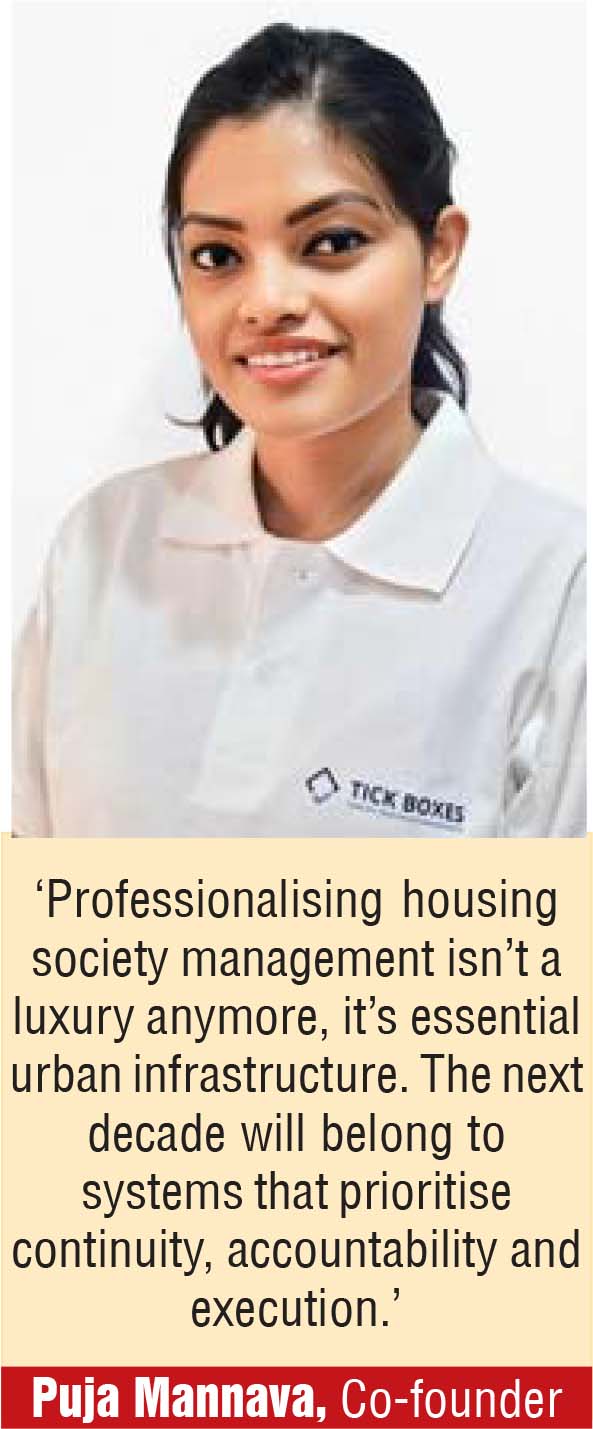
Maintaining that “professionalising housing society management isn’t a luxury anymore, it’s essential urban infrastructure,” Puja Mannava, Co-founder of Tick Boxes, adds, “The next decade will belong to systems that prioritise continuity, accountability and execution.”
August 31, 2026 - Second Issue

Industry Review


VOL XVII - 12
August 16-31, 2026
Want to Subscribe?
Read Corporate India and add to your Business Intelligence
Unlock Unlimited Access
Lighter Vein

1 Year *
Subscription
Rs 1800 /-
3 Year *
Subscription
Rs 5000 /-
5 Year *
Subscription
Rs 8000 /-
5
International
Subscription
$ 99.99
Read Corporate India and add to your Business Intelligence
Popular Stories

A modern-day enigma and a ramification of humanity's never-ending advancements, e-waste refers to the scum con- cealed by the outward glow of ever-advancing technology.
Archives


Office Address
Unit No. 405, 4th floor, Madhu Industrial Park, Avadh Narayan Tiwari Marg, Mogra Village Road, Andheri (East), Mumbai – 400069.
Call/Whatsapp
If you are interested in advertising with Corporate India, please don't hesitate to contact us. Our team is here to assist you with the process and answer any questions you may have. We look forward to the opportunity to work with you and help your business reach its full potential.
Fill out the form below to subscribe to our newsletter and never miss an update