


Want to Subscribe?
Read Corporate India and add to your Business Intelligence

 Unlock Unlimited Access

Published: March 15, 2026
Updated: March 15, 2026
WHAT goes up comes down one day. This age-old truism has returned to haunt India’s information technology industry as a hitherto booming sector — and the most visible marker of the country’s growing visibility on the global stage — hits an unavoidable speed breaker. The once unstoppable growth engine is facing the uncomfortable, painful reality of slowing demand, rising layoffs, shrinking margins, dramatically declining hiring and dramatically rising job cutting. The most glaring piece of evidence — during the last one year, the industry has cut the number of its employees by as much as 80,000.
JUST two decades back, the Indian IT sector was growing at a galloping 10-15% annually, driven by the IT needs of the West. Today, as the same geography witnesses a severe economic slowdown, large companies there have slashed their technology spending, putting an end to the heady days of mass techie hiring and bringing in its wake mass layoffs. Needless to say the IT stocks which was being considered as blue chip stocks were sliding down today under heavy pressure of selling avalanche.
$ 300 billion Indian information technology industry, which has for long reflected the country’s remarkable economic rise, what with huge campuses in Bengaluru – the ‘Silicon Valley’ of India — Hyderabad, Pune and Chennai emerging as factories of the digital age, powering global corporations, creating millions of white-collar jobs and transforming India into the ‘back office of the world’, is today facing a great slowdown. The once unstoppable growth engine is facing the uncomfortable, painful reality of slowing demand, rising layoffs, shrinking margins, dramatically declining hiring and painfully rising job cutting. Companies like Tata Consultancy Services (TCS), Infosys, Wipro and HCL Technologies, which helped turn India into the world’s outsourcing powerhouse, have lost their sheen. During the last one year, the industry has cut the number of its employees by as much as 80,000.
An industry that once promised limitless opportunities is passing through a most difficult situation. Job cutting is rapidly rising and hiring has dramatically slowed down, projects are being delayed, automation is fast reshaping jobs, and the growth rate that once touched double digits has dropped to low single digit in recent times. What exactly is happening inside India’s most celebrated industry is anybody’s guess. But it is certainly a disturbing scenario.
In the 2000s and 2010s, the Indian IT sector routinely grew at 10- 15% annually, driven by the rising outsourcing demand from the US and Europe. Today, the story is quite different. The US and Europe, which were the focus of our IT exports, are facing a severe economic slowdown. With rising interest rates, escalating inflation and growing global uncertainties on account of spreading geopolitical tensions, companies in these countries have slashed their technology spending. Fewer large deals have delayed digital projects and, taking advantage of this, clients are renegotiating contracts. For IT companies that delay on billable hours, the effect has been immediate.
Perhaps the most dramatic shift has been the collapse of mass hiring. At one point, India’s top IT companies hired hundreds of thousands of engineers each year. Today, to get a job in an IT company has become next to impossible as hiring has slowed down drastically to an extent unheard of in the industry so far. For example, in fiscal 2024, the top five IT companies hired 17,764 employees. But during fiscal year 2025-26 (April 11, 2025 to March 10, 2026), the number of employees hired has nosedived to just 170!
This dramatic drop reflects caution across the industry as companies try to control costs and improve productivity. For engineering graduates entering the workforce, the impact has been severe — campus placements that once guaranteed jobs are now uncertain or greatly delayed.
The slowdown has also triggered layoffs and reduced salary hikes. Comments a senior IT engineer, “Till yesterday, to get a job in a top-tier IT company was considered a godsend. Now, around 80,000 employees have been removed and existing employees are wondering whether they will be able to retain their jobs. Tata Consultancy Services (TCS), the largest IT company in the country, has announced plans to cut around 12,000 employees – one of the largest workforce reductions in the company’s history.”
There are several factors which have dramatically changed the future of the Indian IT industry. First of all, fastgrowing and widening geopolitical tensions have vitiated the global environment, adversely affecting supply chains, business activity and the export-import business, and resulting in an economic slowdown virtually all over the globe. This marked economic slowdown, especially in the US and Europe, has led to a drop in demand for outsourcing IT services.
Unfortunately, geopolitical tension is mounting day by day. There is some improvement in the military confrontations between Israel and Hamas, and between India and Pakistan. But the prolong Russia-Ukraine war refuses to come to an end. Meanwhile, the Middle East has turned into a battleground, thanks to US President Donald Trump's decision to wage a war against Iran. People, including political leaders, have started talking about the possibility of a third World War. Such a disturbing global situation is bound to adversely affect business activity everywhere in the globe.
The impact of these growing geopolitical tensions has led to a sharp spurt in crude oil prices, which have shot up from $ 65 per barrel to cross the $ 100 mark.
If any one factor is looming over the IT industry's future more than any other, it is artificial intelligence (AI). Automation tools and generative AI can now write code, test software and manage customer support systems - tasks that once required large teams of engineers.
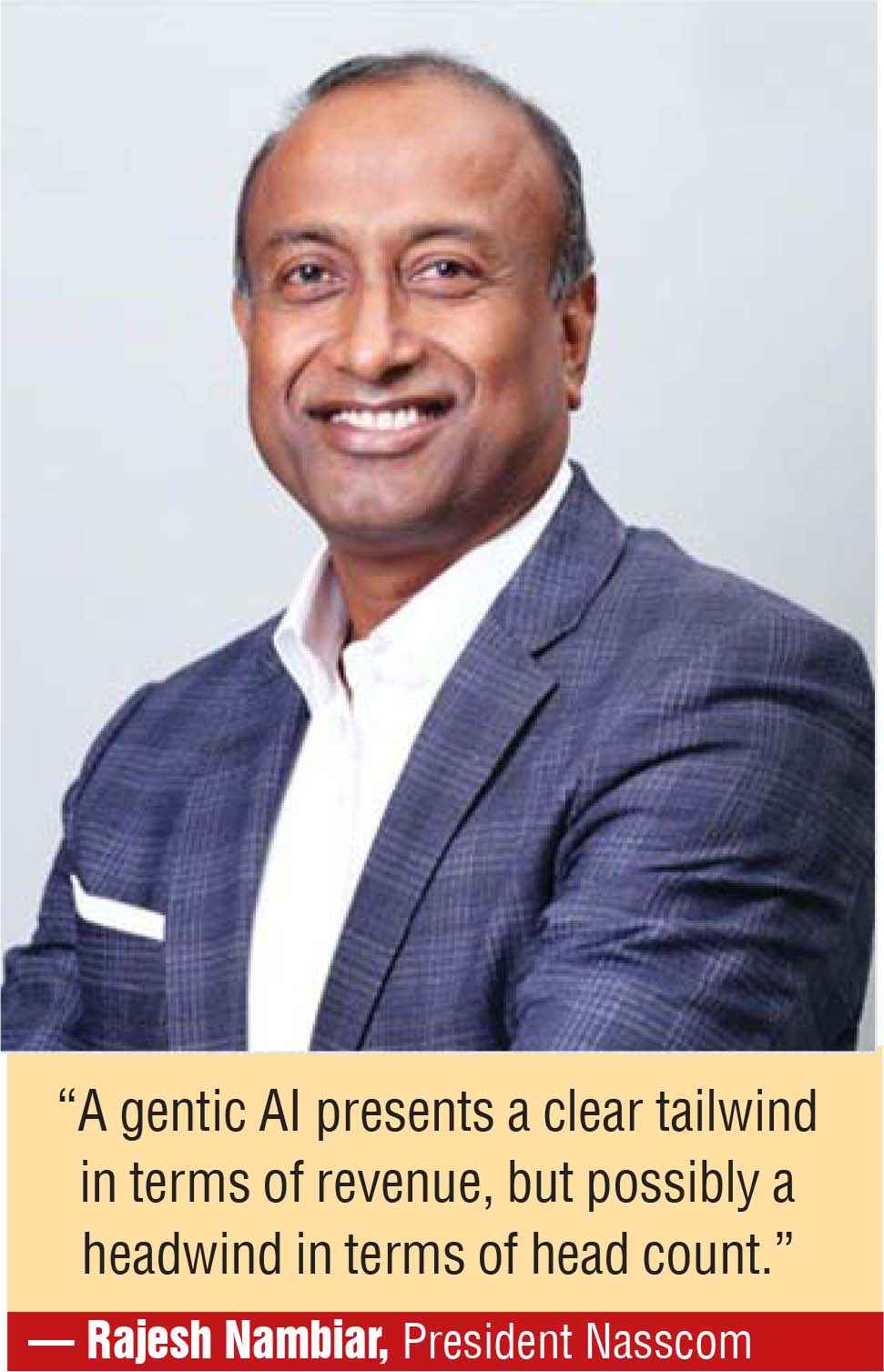
Industry leaders admit that AI will transform the employment model. Agentic AI presents a clear tailwind in terms of revenue, "but possibly a headwind in terms of headcount", maintains Rajesh Nambiar, president of NASSCOM.
Experts estimate that hundreds of thousands of roles globally could be automated over the coming decade as companies adopt AI-driven software development.
Although costs are a perennial issue for Chief Information Officers (CIOs), they have taken on a heightened importance this year due to the significant increases for goods and services. Sharply rising IT costs have put pressure on innovation in recent years due to inflation and the geopolitical environment.
"Cost containment and control continues to be a significant issue, as we're seeing massive increases in some technology costs such as licensing. Some CIOs are seeing multifold increases in renewal costs and they have very limited options at that point but to pay," says Dave Borowski, senior partner and DC office lead at digital services firm West Monroe. FICO's Trkay also lists expense management as a top issue, although he cites costs related to AI and cloud.
"The rapid adoption of generative AI has led to escalating and often unpredictable cloud expenditures, particularly due to GPU-intensive workloads and fragmented pilot projects," he says, adding that CIOs must balance innovation and fiscal responsibility. "This entails not only enabling cutting-edge AI solutions but also ensuring that these initiatives are cost- effective and aligned with business objectives. IT departments must implement robust governance frameworks to evaluate the return on investment (ROI) of AI projects and prevent resource wastage."
To do that, Trkay says FICO is adopting a more disciplined approach to AI investments by prioritizing high-value use cases and focusing on AI projects with clear, measurable benefits to the organization; implementing cost optimization tools and applying AI to optimize AI; and optimizing infrastructure and leveraging multicloud strategies.
"This shift from broad experimentation to targeted, ROIdriven AI initiatives represents a maturation in how organizations approach AI balancing innovation with sustainable financial practices, performance with accountability," he adds.
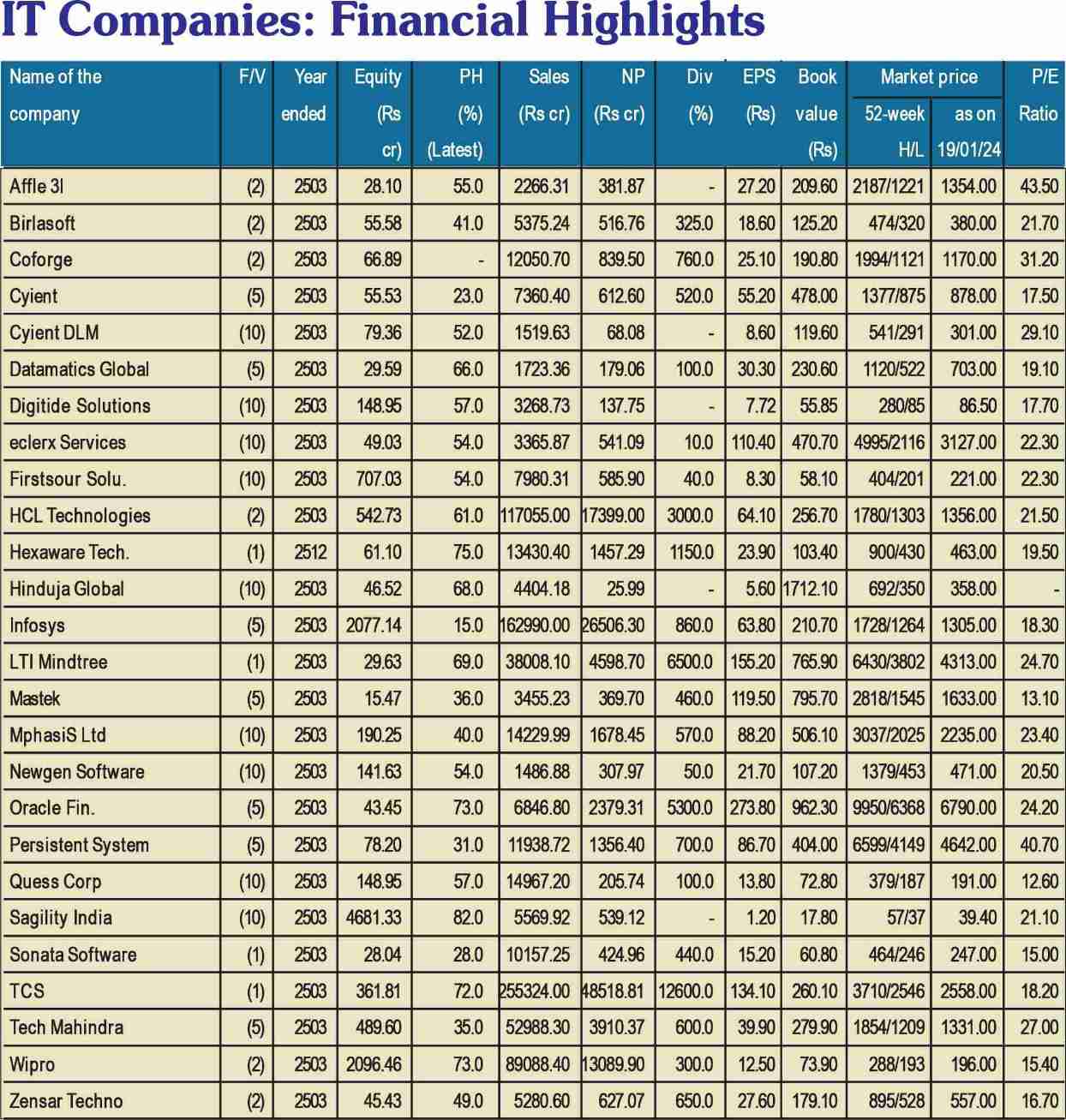
All these factors have hit the stock market sentiment very adversely, with the Sensex, the most popular stock market index based on 30 pivotal shares quoted in the BSE, tumbling from a 52-week high of 86,159 to 78,206 points, and Nifty50, the darling index of analysts based on closing prices of 50 leading stocks quoted on the NSE, sliding from 26,373 to 24,262 points. Needless to say, the worst affected sector was information technology which is facing headwinds from various sides, with the BSE IT index nosediving from 44,323 to 29,118 points and the Nifty IT index dropping sharply from 40,301 to 30,024 points.
Among the leading stocks, Tata Consultancy Services (TCS) was down from Rs 1,728 to Rs 1,295. Almost all the IT stocks met with widespread selling, with Wipro declining from Rs 288 to Rs 198, Tech Mahindra from Rs 1,850 to Rs 1,335, HCL Technology from Rs 1,770 to Rs 1,358, LT Mind Tree from Rs 6,430 to Rs 4,317, Happiest Minds from Rs.465 to Rs. 247, and Neogen Software from Rs 1,380 to Rs 460.
Comments a leading stock market analyst, "Indian IT stocks are witnessing a sharp, sustained decline in early March 2026, with the Nifty IT index dropping significantly due to fears over AI disrupting traditional business models, weak earnings, and global economic uncertainty. Major firms like TCS, Infosys and Wipro have seen intense selling pressure, with the sector previously recording its steepest monthly decline in February 2026 since 2008."
However, despite the current turbulence, the Indian IT sector is far from collapse. Of course, the shape of the industry will not remain the same. The golden era of outsourcing may be fading. However, revenues are still expected to cross $300 billion soon, marking another milestone for the industry.
But the next phase of growth will look very different from the past, as the shape and size of the industry will be transformed. The days of bumper hiring will be over and tech-savvy, high skilled workers will rule the roost. The companies that thrive will not be the ones with the largest workforce -- but the ones with the most advanced technology and talent. What comes next could be the age of AIdriven innovation.
It often seems the technology industry is in the business of solving everyone else’s problems, but tech companies are facing plenty of issues of their own. As is true in every industry, tech businesses have to keep up with the lightning fast changes in technology trends. Unlike leaders in other industries, tech businesses must also figure out how to compete with the new technology tools and services hitting the market.
Tackling tall challenges is all in a day’s work for tech leaders, but, to do that, the first step is defining those challenges. Below, 20 members of Forbes Technology Council detail some of the issues tech companies are facing right now and how individuals and the industry as a whole can address them.
1. Dealing with new and increasing cyberattacks
The increasing frequency and sophistication of cyberattacks is a continuing issue for tech companies and any organization that uses computers. Technology companies should invest in cybersecurity solutions and their people to better detect, prevent and respond to various types of cyber threats. Every organization should regularly test its defences to ensure security measures are up to date and effective. — Tim Medin, Red Siege
2. Leveraging new technology for tangible business outcomes
The top issue facing the technology industry continues to be how contemporary technology can be leveraged to realize tangible, defined business outcomes. Given the explosion of digital technologies and their fast evolution, end-user industries are finding it hard to create business-led technology adoption pathways that help them break out of their legacy technology capabilities. — Sandeep Kumar, ITC Infotech
3. Maximizing the capacity and capability of teams
Every technology company is under pressure to perform and grow profitably — a shift away from the 'grow at all costs' model of the past. This usually means adding fewer people while still expanding the work. Companies must focus on reducing job complexity while investing in training to increase the capability and capacity of the team. Prioritize through a lens of largest impact for the customer. — Lou Senko, Q2
4. Harnessing AI's potential
The integration of artificial intelligence has become a major concern in the fast-paced world of technology. While some fear job displacement, opportunities for growth and innovation are real. Creativity will be crucial in navigating this evolving landscape to chart a successful path. Leaders must foster a culture of experimentation and mutual respect to fully harness AI's potential. — Edwige Robinson, T-Mobile
5. Proving they have a Unique Selling Proposition
Few sectors have been more impacted by recent economic shifts than the technology sector. Pressures continue to mount as tech companies exhaust the massive influx of funding seen in 2020 through 2022, so it's incumbent on tech companies to prove their longevity, their innovative niche or, at minimum, their compatibility with a tech stack that makes them desirable for acquisition. — Elizabeth Duffy, Astraea
6. Leveraging Generative AI
Generative AI will change the game forever. How do you control it, and then how do you leverage it? The best way is to eliminate repetition. Generative AI has proven to be highly effective at tasks with boilerplate code, as well as tedious work such as documentation. Organizations willing to rip the band-aid off now will race ahead of their competition. — Andrew Lau, Jellyfish
7. Doing more with less
Industry pros must do more with less, secure the hybrid cloud and embrace AI and automation while achieving compliance, modernizing infrastructure and furthering the zero-trust journey. Leaders should rationalize infrastructure and tools to lower costs while leveraging immutable network intelligence to make new, AI-based security and performance solutions reliable and effective. — Shane Buckley, Gigamon
8. Recognizing hype cycles
I think the biggest issue is hype cycles. What we have seen with crypto, the bank crisis and now generative AI are rapidly moving trends that have been called 'hype cycles' because of how much content is pushed focusing on one topic. I think it is important for industry leaders to recognize when we're in the midst of a hype cycle and react thoughtfully. — Caroline McCaffery, ClearOPS
9. Dealing with a shortage of ready talent
The lack of ready-to-deploy talent with in-demand skills is constraining business transformation. Technology advancements have outpaced talent readiness. A case in point is generative AI, which has made a loud entrance. Leaders need to build an organizational ecosystem that attracts, trains and retains talent. AI-enabled processes, tools and accelerators can help teams achieve higher productivity. — Prashant Bhavaraju, TRIANZ
10. Managing technical debt and tool sprawl
All technology leaders today face continuously expanding technical debt and tool sprawl. These challenges are exacerbated by the ever-accelerating pace of new technology introduction, which continues to outpace IT resources. To overcome this, leaders should shift to a continuous refactoring mindset and deliver automation and empowerment with high-productivity tools to accelerate business value. — Jeremiah Stone, SnapLogic
11. Preparing for emerging financial pressure
Tech companies are up against financial pressure as the stock market is moving sideways and investments have dried up. The biotech industry is facing additional hurdles, as many major pharmaceutical product patents will expire in the next seven years. As these products total $200 billion in revenue, companies must use AI to rapidly innovate and replace this potentially huge loss. — Carl T. Foster, Standigm
12. Ensuring real-time execution and availability via the Cloud
One major challenge is leveraging cloud tech for real-time execution while remaining available during connectivity gaps. Balancing edge capabilities and cloud hosting raises questions about duplication and security. Frank discussions on solution availability, security and costs, along with improving connectivity options, can guide decisions. Simplified technologies for on-premises deployment offer potential solutions. — Bill Rokos, Parsec Automation
13. Addressing poor user experiences
Businesses must recognize the true costs of a poor user experience and invest in tools to address it. With the rise of AI, the traditional IT challenge of device visibility and curation has expanded to ensuring that the right systems are in place to incorporate these technologies. IT teams need end-to-end visibility into the user experience and the means to remediate any issues in real time, at scale. — Ian van Reenen, 1E
14. Adapting to changing customer behaviours
One of the top issues in tech is changing customer behaviors in the AI age, especially concerning privacy. Leaders must balance hyper-personalization with data protection. Also, the rise of ethical consumerism demands businesses align AI applications with evolving customer expectations on privacy, social justice and environmental responsibilities. — Jean-Baptiste Hironde, MWM
15. Optimizing data centre operations
Artificial intelligence applications require servers with unprecedented power density. That degree of high-performance compute puts pressure on data centre operators to enable more scalability and network density, as well as to evolve cooling systems to keep GPU and TPU chips operating at peak capacity. Unless that happens, realizing the full potential of AI will be difficult. — Juan Font, CoreSite
16. Balancing service quality with ethical AI use
The top issue in the tech industry involves ensuring ethical AI use, data privacy and economic sustainability without compromising service quality. Leaders must align AI with societal values, enhance data security and balance investments and returns without compromising quality, service and integrity. Addressing these challenges requires comprehensive strategies and collaboration across sectors. — Jo Debecker, Wipro
17. Delivering high-quality employee experiences
To provide a high-quality customer experience, organizations must deliver consistent, high-quality employee experiences. Through economic uncertainty, many tech companies have lost their commitment to the important initiatives that help employees thrive. Taking the 'safe option' of cutting back during tough times will yield short-term gains at a long-term cost — proving dangerous to a company's success. — David Levin, Poppulo (Formerly FWI | Poppulo)
18. Rethinking the collection and use of personal data
There's a growing perception that personal data is a toxic asset. With personal data accumulated and sold with little in terms of genuine informed consent, there are increasing concerns that technology is being used to manipulate rather than to elevate. Industry leaders need to revisit their attitudes about third-party cookies and embrace safety by design principles, rather than retrofitting ethics. — Ajay Khari, Meltwater
19. Finding new talent in an industry dominated by Big Tech
The tech industry is wrestling with the dominance of Meta, Apple, Microsoft, Amazon and Alphabet and the talent war among them. New companies can't compete in recruiting the best talent, which hampers innovation and disruption of the market. Three US companies operate and control most of the online world, and consulting firms compound the issue by educating their workforce on these platforms. Industry leaders should be more open to new and fresh ideas. — Lasse Andresen, IndyKite
20. Filtering out 'Data Noise'
The digital age has ushered in transformative possibilities, but it has also presented a challenge: the overwhelming deluge of data. This is an overall business concern. When you have multiple devices speaking to each other, the volume of data generated can blur critical information, leading to decision paralysis or oversight of events. To navigate this complexity, we must filter out the 'data noise'. — Alan Stoddard, Intellicene
(Prepared by an expert panel of Forbes Technology Council)
At a time when Artificial Intelligence (AI) has unsettled the Indian IT sector, K Krithivasan, CIO and Managing Director of the country’s leading IT company, TCS, remains optimistic.
Insisting that AI will not take away livelihoods, he has exhorted junior and senior IT industry staff to “dirty their hands” and has encouraged them to leverage AI for customer solutions, even if it cannibalises company revenue. The company encourages not just junior employees but also senior management to “dirty their hands” and understand how to build using the technology, Krithivasan said at the Nasscom Technology and Leadership Forum in Mumbai recently.

The TCS chief stressed the need to create AI fluency within the organisation to ensure that associates are not scared of the technology and understand its potential. The IT giant announced an annualised AI revenue of $1.5 billion after completing more than 5,500 projects since 2023. The company has been hiring top talent in niche areas, while reporting considerable workforce rationalisation.
Last year, TCS announced plans to become an AI-led technology services company. Meanwhile, Ashok Baswani, Managing Director and CEO, Kotak Mahindra Bank, said at the same event that businesses can no longer deny AI transformation.
August 31, 2026 - Second Issue

Industry Review


VOL XVII - 12
August 16-31, 2026
Want to Subscribe?
Read Corporate India and add to your Business Intelligence
Unlock Unlimited Access
Lighter Vein

1 Year *
Subscription
Rs 1800 /-
3 Year *
Subscription
Rs 5000 /-
5 Year *
Subscription
Rs 8000 /-
5
International
Subscription
$ 99.99
Read Corporate India and add to your Business Intelligence
Popular Stories

A modern-day enigma and a ramification of humanity's never-ending advancements, e-waste refers to the scum con- cealed by the outward glow of ever-advancing technology.
Archives


Office Address
Unit No. 405, 4th floor, Madhu Industrial Park, Avadh Narayan Tiwari Marg, Mogra Village Road, Andheri (East), Mumbai – 400069.
Call/Whatsapp
If you are interested in advertising with Corporate India, please don't hesitate to contact us. Our team is here to assist you with the process and answer any questions you may have. We look forward to the opportunity to work with you and help your business reach its full potential.
Fill out the form below to subscribe to our newsletter and never miss an update