



Want to Subscribe?
Read Corporate India and add to your Business Intelligence
 Unlock Unlimited Access

Published: May 31, 2026
Updated: May 31, 2026
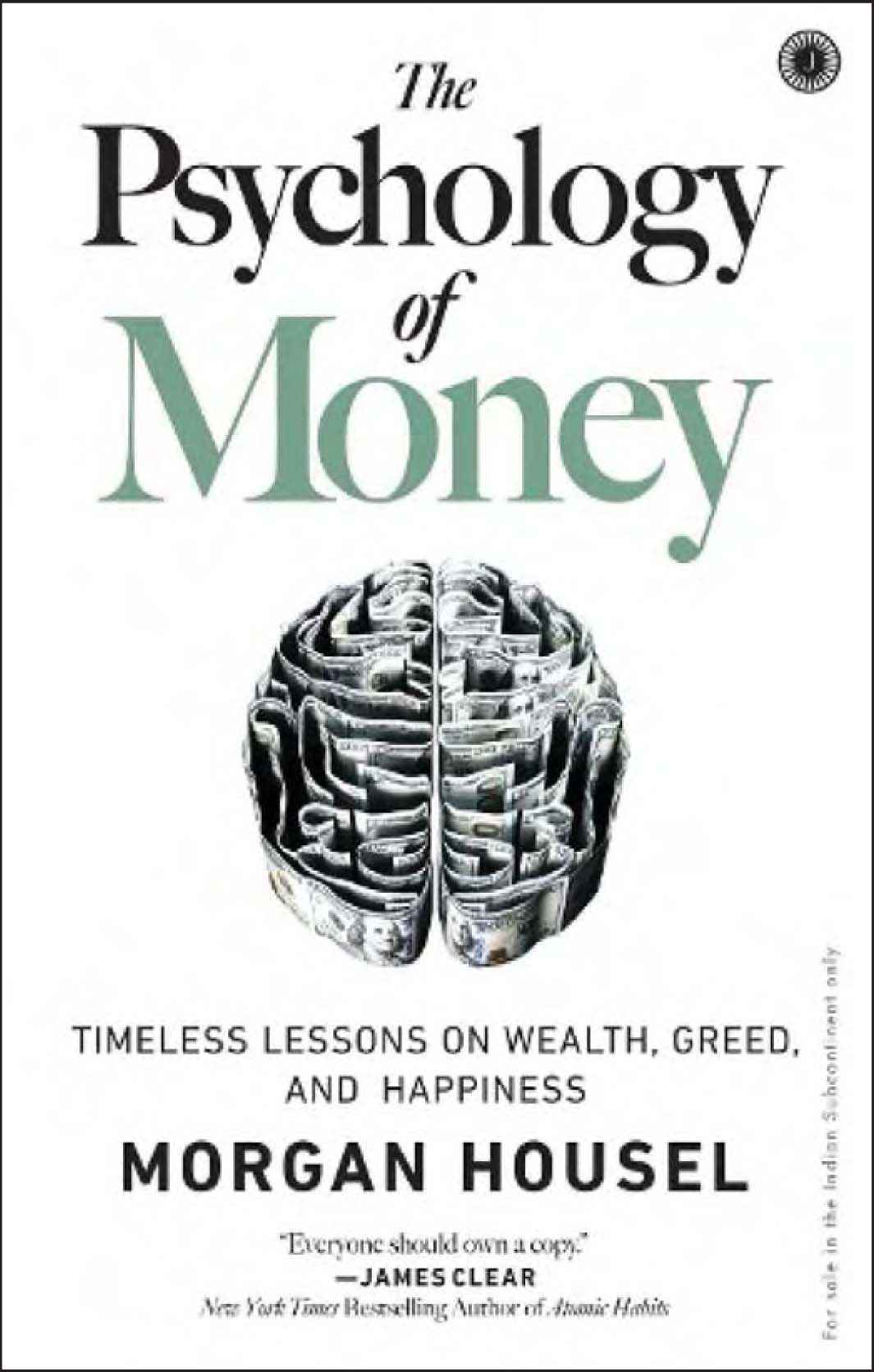
By MORGAN HOUSEL. Pub: Jaico Publishing House, Pages: 252, Price: Rs 399.
Often, the question cropping up in one's mind is something akin to this: Which of the two is easier to achieve — earning money in abundance or managing the same wisely and ensuring that it grows rapidly? Perhaps, it is the former for many of us. The reason is simple: Investing hard-earned money acquired over several years prudently is definitely a much more difficult task. One has to find good and safe financial instruments, and take the right decisions at the right time. This is true for both individuals and businesses. And, when the funds become huge, the risk involved is greater.
In the book under review, the author, Morgan Housel, a former columnist for Wall Street Journal, a two-time winner of the ‘Best in Business’ award from the Society of Business Editors and Writers, and a distinguished business/financial journalist, has succinctly analysed the issue in his own inimitable way. Through 19 short stories and in as many chapters, he has explored the strange and different ways people think and finally act about money, and brings out the importance of human behaviour played out in the realm of investment.
Before proceeding further, a word about the stories narrated by the author would not be out of place. Being a foreign author (American), all the stories and names mentioned are either US-based or of other developed countries and they might not resonate with our readers. Hence, I am avoiding them, unless they happen to be famous personalities like Warren Buffett, Bill Gates, etc. At the same time, I intend dwelling on some of his investment ideas, which would provide the readers a broad view of how major investment decisions are taken by several people and how certain factors play a vital/decisive role.
According to the author, in the real world, people don't take financial decisions on a spreadsheet. They take them at a dinner table, or in a boardroom, where various other factors like ego, pride, marketing and offer of incentives play a vital role, affecting the effectiveness of the decisions. Besides, many working people do not have a financial plan -- all they have is a collection of ideas on investing their money. It is common knowledge that some people buy an insurance policy on the insistence of a close friend, some start a SIP, again on a colleague's word but not necessarily after a careful study as to whether the same would meet his requirements. Yet some, as they approach their retirement day, hurriedly put together a plan which does not take care of all their needs in the future. Such instances are, in fact, galore. For, basically, patchy investments do not always lead the investor anywhere near the goal of financial security in his post-retirement period as they have all been made in an impulsive mood. These plans might occasionally work in some cases for a while, but definitely not in the long run.
This is where the author's threadbare analysis of the investment psychology of different individuals comes to play a decisive role. Citing the case of Microsoft founder Bill Gates' rise to fame and glory, Morgan Housel has pointed out that apart from being ‘staggeringly smart’ and ‘having a vision for computers that even most seasoned computer executives couldn't grasp’, Gates had luck on his side. Terming luck and risk ‘siblings’, he is of the view that every outcome in life is guided by forces other than individual effort. While Gates was favoured with Dame Luck in his venture, his close friend Kent Evans was not that lucky. Both worked together for some time and Kent could have been one of the founding partners of Microsoft along with another colleague, Paul Allen. But that was not to be as Kent died in a mountaineering accident. Bill Gates had the one-in-a-million good fortune to end up at the famous Lakeside Computer School, which helped shape his career, while Kent Evans was the victim of a one-in-a-million fatal occurrence and could not finish what both had set out to achieve.
The author goes on to argue in one chapter that getting wealthy and staying wealthy are not always the same. There are several ways to get wealthy and plenty of books are available on the subject. However, when it comes to staying wealthy, there is, perhaps, only one way — being miserly with expenses. Morgan points out that investing money always involves taking risks, being optimistic and working longer. But keeping one's money safe requires just the opposite trait — being humble and guarding one's wealth lest it is robbed, or misappropriated by advisers. The habit of being patient has to be developed and one has also to be frugal and accept that luck has a role to play in acquiring wealth. One should never rest on one's laurels or become complacent. One has to cultivate the habit of ‘sticking around for a long time’ in whatever one is doing. Here is where patience is needed and the knack of holding out against odds/adversity.
Referring to yet another psychological trait among people and terming it ‘reactance’, the author adds that investors prefer to be in the ‘driver's seat’ and in full control of everything that matters. The highest form of wealth one can have is the ‘ability to wake up every morning and say, “I can do whatever I want today”.’ This ability is the freedom one can have to do what one wants, when one wants, and for as long as one wants. This freedom is priceless. It is the “highest dividend that money pays.” Having control over doing what one wants is, perhaps, the “broadest lifestyle variable that makes people happy.” Aligning money towards a life that lets one do what one wants/likes the most and for as long as one wishes provides an incredible return. Quoting a successful young entrepreneur who became rich by taking a small job paying $ 20K per annum, and managing to save $12,000 every year by being frugal in all his expenses, the author adds that in a few years, the person could quit his job and become a full-time musician, something he wanted to do for long!
Another pertinent point made out by the author is of great relevance. People generally aspire to be respected and admired by others and money is used just as a tool for achieving the same. But buying and owning fancy stuff does not get the respect or admiration of others. If gaining respect and admiration is one's goal, one has to be careful in seeking it. In fact, humility, kindness and empathy, generally the most sought-after qualities, are the qualities needed to gain the respect and admiration of people. As an illustration, Morgan gives the example of people moving about in luxury cars like Ferraris, Rolls-Royces, etc. When one sees such cars on the road, the instantaneous feeling coming up in one's mind is not about the people in the cars or the drivers, but about when one can have the same. Here, one is not admiring or respecting the people in the car but only the vehicle!
To summarize: there is no exact/fixed rule in the realm of investment. It changes from individual to individual. And it is difficult to prescribe one set of rules for everyone to follow. Various imponderables operate and situations keep changing rapidly. Here is where the role of luck plays a significant role. Its role cannot be exaggerated. One person might have carefully planned out his investments and executed them, but by a quirk of fate or bad luck, suddenly he could turn into a pauper owing to external factors like a major war. Similarly, some emotional/personal factors can also affect one's investment decisions. When a person takes investment decisions when he is in a happy frame of mind, perhaps they can turn out to be money spinners, rather than when he is emotionally affected by the news of the death of a very close person/mentor.
In another story, the author points out of an instance when a reputed doctor prescribed expensive medicines and treated a patient suffering from a serious ailment, but when it came to himself (he also had same disease), he was satisfied with swallowing some palliatives! Here, the doctor could have been emotionally upset when his patient, whom he had caringly treated, passed away, and could have turned philosophical, thinking that everyone has to die one day or the other. At one stage, even investments are like that.
In short, the author's main theme is: Doing well with money isn't always about what you know. It's about how one behaves. And, in his own words, “Behaviour is something hard to teach, even to really smart people.” His observations often say things that haven't been said before, and they make sense. The author, without a doubt, is a rare writer who translates complex concepts into gripping and easy-to-digest narratives. The book is quite an interesting read from cover to cover. The interesting thing is that the points narrated hold good for everyone and at all places as they essentially talk about human behaviour.
— V Raghuraman
July 15, 2026 - First Issue

Industry Review


VOL XVII - 10
July 01-15, 2026
Want to Subscribe?
Read Corporate India and add to your Business Intelligence
Unlock Unlimited Access
Lighter Vein

1 Year *
Subscription
Rs 1800 /-
3 Year *
Subscription
Rs 5000 /-
5 Year *
Subscription
Rs 8000 /-
5
International
Subscription
$ 99.99
Read Corporate India and add to your Business Intelligence
Popular Stories

A modern-day enigma and a ramification of humanity's never-ending advancements, e-waste refers to the scum con- cealed by the outward glow of ever-advancing technology.
Archives


Office Address
Unit No. 405, 4th floor, Madhu Industrial Park, Avadh Narayan Tiwari Marg, Mogra Village Road, Andheri (East), Mumbai – 400069.
Call/Whatsapp
If you are interested in advertising with Corporate India, please don't hesitate to contact us. Our team is here to assist you with the process and answer any questions you may have. We look forward to the opportunity to work with you and help your business reach its full potential.
Fill out the form below to subscribe to our newsletter and never miss an update