


Want to Subscribe?
Read Corporate India and add to your Business Intelligence

 Unlock Unlimited Access

Published: September 30, 2026
Updated: September 30, 2026

With AI radically disrupting the Indian IT scene, companies are scrambling to adapt by ditching headcount and low-cost labour models for which Indian IT has been hitherto known the world over.
Even as the spectre of unemployment or delayed employment looms over thousands of aspiring young Indian techies, with job offers rescinded and net headcounts down, the industry is gearing for an AI-enabled makeover.
The simple fact that AI agents are collapsing software development costs to near-zero is a direct challenge to the Indian industry’s current business model. Ergo, by automating routine processes, addressing the realities of global captive centres and embracing outcome-linked commercial models, the industry is repositioning itself as an AI-enabled global player.
As experts note, the era of scaling tech businesses purely through headcount expansion is drawing to a close. The future belongs to lean, automated, high-margin software organisations capable of deploying intelligent systems at global scale.

For three decades, the corporate blueprint of the Indian Information Technology (IT) sector was as elegant as it was profitable. ‘Recruit engineering graduates en masse, train them in standard coding languages, and bill Western clients by the hour’ were the SOP (standard operating procedure) of the industry. This classic labour-arbitrage engine transformed India into the tech back office of the world.
Today, that engine is stalling. Across the technology corridors of Bengaluru, Hyderabad and Pune, thousands of engineering graduates are holding deferred onboarding letters, with some waiting over a year to start their career. Prominent tier-I tech companies have rescinded job offers entirely to optimise internal bench strength. For the first time in the industry’s history, net headcount additions have flattened, senior hiring has frozen, and entry-level packages have stagnated.
This is not a temporary cyclical downturn. The Indian IT sector – valued by industry body NASSCOM (National Association of Software and Service Companies) at $ 315 billion (approximately Rs 26,50,000 crore) for the financial year ended March 2026 – is experiencing a profound, permanent structural shift. A powerful convergence of generative AI (GenAI), protectionist macro-economics and an invisible internal threat is aggressively dismantling the old per-seat billing architecture. The sector is entering a high-stakes transition from an employee-heavy volume game to an automated value game.
| Inside Indian IT | |
|---|---|
| Market size | $315 billion |
| Software services market | $271 billion |
| IT products market | $23 billion |
| IT hardware market | $21 billion |
| Share of IT services | 86% |
| Share of IT products | 7% |
| Share of IT hardware | 7% |
| Total employees | 59,50,000+ |

K Krithivasan, MD and CEO, TCS

Rajesh Nambiar, President, NASSCOM

Sridhar Vembu, Co-Founder, Zoho Corporation
The current crisis facing Indian IT companies is a multi-front disruption. While external geopolitical forces are squeezing traditional market access, internal automation is rewriting the mechanics of software production. Concurrently, a subtle structural shift within India’s borders is eroding the client base of established tech services firms.
The primary threat is structural. GenAI can instantly execute basic front-end coding, debugging and software testing – the exact high-volume tasks traditionally assigned to fresh engineering recruits on the bench. Prominent venture capitalists have noted that AI agents are collapsing software development costs towards zero. For an industry built on billing clients for human hours, an automation tool that lets one engineer do the work of five is a direct challenge to the business model. Indian tech giants are fighting back. They are actively building AI utilities that automate their own clients’ workflows, effectively reducing their own near-term billable hours to protect long-term corporate partnerships.
Simultaneously, international boundaries are tightening. Protectionist policies and strict outsourcing curbs in primary Western markets – especially anti-outsourcing measures unveiled by US President Donald Trump – are creating severe operational friction. High interest rates in the US have forced Fortune 500 banks and retail giants to curb discretionary tech spending. Tightened visa regulations and local nearshoring mandates mean that Indian IT companies can no longer easily deploy large teams of engineers overseas for on-site client implementation, squeezing traditional cross-border margins.
| IT's Triple Threats |
|---|
| Labour-heavy, volume-based business model disrupted by AI |
| Protectionist policies in the Western world, especially the US, creating severe operational friction |
| Top-tier engineering talent and high-margin contracts cornered by GCCs, eroding software companies’ revenues |
While AI and Western restrictions dominate public discourse, an equally disruptive threat is growing within India in the form of global capability centres (GCCs). Instead of outsourcing software needs to local services companies like Tata Consultancy Services (TCS), Infosys or Wipro, multinational enterprises are directly setting up GCCs – their own captive technical units – across the metros.
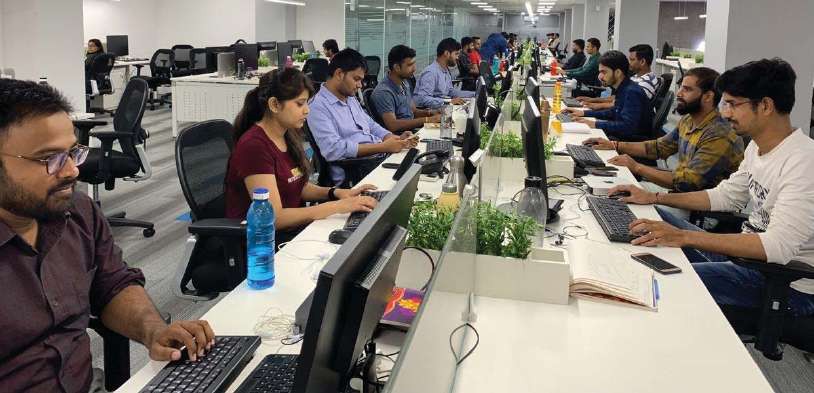
Lacking diversified portfolios, many mid-tier IT entities have suffered significant margin compression.
According to data compiled by Zinnov and IBEF, over 1,700 GCCs now operate in India, employing roughly 19 lakh professionals and capturing $ 64.6 billion in revenue. Western companies are building their proprietary AI and data architectures inside these wholly-owned captives by absorbing top-tier engineering talent. This leaves traditional Indian IT companies to handle lower-margin legacy maintenance and system integration.
The financial and structural consequences of this three-front challenge are heavily concentrated in specific segments of the Indian tech landscape. To accurately gauge the impact, the Indian tech industry must be divided into its two core sub-sectors: (1) Software services, including engineering research and development (ER&D) and business process management (BPM), and (2) Enterprise software or IT products, including software as a service (SaaS). The software services segment is the historic core of the industry, commanding around 93% of the total revenues ($267 billion or Rs 24,57,000 crore) of the $315-billion market. The IT products segment is a smaller, highly scalable segment accounting for roughly 7% of the total revenues (around $23 billion or Rs 1,93,000 crore).
The current structural headwinds are impacting these two business models differently. The labour-heavy software services sector is experiencing a clear deceleration. Estimates suggest that AI-induced automation is driving a 20% to 50% deflationary impact on traditional application managed services, as tasks are finished much faster with fewer billable hours. Faster software development cycles and client-side budgeting constraints mean that their multi-million-dollar service contracts are shrinking or getting delayed.
Conversely, pure-play software product firms have shown greater resilience. Their IP subscription models are highly scalable and stand to gain directly by embedding premium AI features directly into software licences. Firms like Zoho and Freshworks remain insulated from labour-arbitrage issues because they sell scalable subscription software. These product companies operate with high gross margins (often 75% to 85%), as code written once can be scaled to thousands of corporate users without requiring proportional headcount additions. While their valuations have normalised alongside broader software market trends, their underlying revenues continue to expand, as global enterprises prioritise software consolidation.
The pain of this transition has fallen unevenly across the corporate spectrum, with small- and mid-cap IT companies bearing the brunt. Lacking diversified portfolios, many mid-tier players have suffered significant margin compression. Caught in a price war, smaller vendors are forced to discount their services to keep clients who are otherwise tempted to consolidate their vendors or migrate to cheaper automated AI platforms. “The broader sector is still dealing with the effects of revenue deflation in IT services and uncertainty around how quickly AI-led demand can offset traditional pricing pressure,” points out ICICI Securities.
Operating margins for services companies have faced downward pressure. Lower-tier contracts are being renegotiated by Western clients demanding 20% to 30% cost reductions through AI automation. Subdued financial results of the IT companies in general are, in turn, reflected in their stock prices. The Nifty IT index, which tracks major listed Indian tech equities on the National Stock Exchange (NSE), has dropped by 25.03% from its 52-week high of 40,301 points to trade at the 30,213 mark on August 18, 2026, erasing crores of rupees in market capitalisation.
This market correction reflects a direct impact on operational metrics. For decades, headcount growth mirrored revenue growth. Today, that connection is broken. NASSCOM highlights that the industry has added a modest net 1,35,000 jobs in FY26, pushing total employment to about 59.50 lakh. The figures represent a flat 2.3% YoY growth in the headcount.

TCS, for instance, officially executed a targeted 2% workforce optimisation plan aimed at roughly 12,000 middle- to senior-level roles and employees with non-client-facing or outdated skill sets. Infosys, Wipro and HCLTech managed to finish FY26 with flat or slightly positive net headcounts despite heavy quarterly churn. Tech Mahindra, on the other hand, joined TCS as the only other major player to shrink its workforce by 1,108 on a net annual basis.
When the numbers are sliced and diced, it shows that the top five IT service companies ended FY26 with a combined net reduction of 6,981 employees. This completely reverses the mild hiring recovery seen in FY25. The standard mass recruitment from engineering college campuses has slowed down dramatically. Onboarding delays stretching between six to 18 months are common, as companies work through unutilised bench capacity before adding fresh personnel expense.
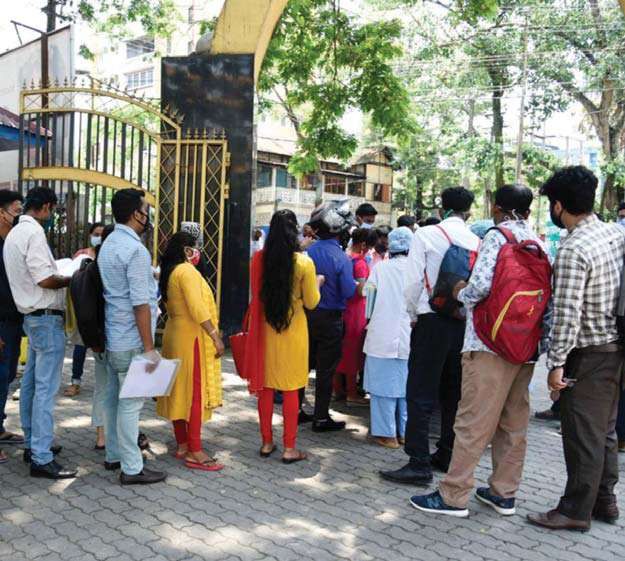
The standard mass recruitment from engineering college campuses has slowed down dramatically.
With entry-level intake drastically reduced, growth of disposable income among the urban middle class has flattened. This slowdown has triggered a noticeable cooling effect on consumer spending, directly reducing demand for urban residential real estate, mid-premium automobiles, consumer electronics and retail dining. As the industry recalibrates to a less labour-intensive, high-value AI ecosystem, the Indian economy faces a critical structural challenge of finding new sectors capable of absorbing the lakhs of skilled graduates entering the workforce every year.
| Company | Revenue (Rs cr) | YoY Change (%) | Net Profit (Rs cr) | YoY Change (%) |
|---|---|---|---|---|
| TCS | 2,67,021 | 4.6 | 49,454 | 8.8 |
| Infosys | 1,78,650 | 3.1 | 29,474 | 10.2 |
| HCLTech | 1,30,144 | 11.2 | 17,361 | -0.2 |
| Wipro | 92,624 | 4.0 | 13,200 | 0.47 |
| Tech Mahindra | 56,815 | 7.2 | 4,811 | 13.2 |
The Big Five: Subdued Earnings. All figures are for FY26. Revenues and net profits in dollars flat or even contracted; rupee revenues and profits look strong due to a weakening Indian currency; the true drop in business volume and revenue is masked by a weak rupee; and severe cost-cutting measures – like halting fresh campus hiring, optimising bench strength and slashing discretionary spending – are protecting profit margins.
| Stock | 52-Week High (Rs) | Sept 30 Price (Rs) | Change (%) |
|---|---|---|---|
| TCS | 3,350 | 2,055 | -38.64 |
| Infosys | 1,728 | 995 | -42.40 |
| HCLTech | 1,780 | 1,227 | -31.04 |
| Wipro | 273 | 158 | -41.91 |
| Tech Mahindra | 1,854 | 1,533 | -17.29 |
In The Red Zone: the Nifty IT index was at 27,704 points on September 30, 2026, a 31.26% drop from its 52-week high of 40,301 points.

| AI-induced automation driving 20-50% deflationary impact on software companies’ traditional application management services |
| Multi-million-dollar service contracts shrinking or getting delayed |
| Unlike software services segment, product companies’ underlying revenues expanding, as global enterprises prioritise software consolidation |
| Expanding AI immensely benefiting IT hardware companies’ businesses with rising demand for computing capacity components like GPUs, accelerators, servers, data centre equipment, etc |
| Smaller IT companies in deep trouble and forced to discount their services to keep clients |
| Investors’ wealth erased by subdued financial results and the consequent drop in IT stock prices |
| Job addition flat at a 2.3% YoY growth of 1,35,000 in FY26 amid hiring freezes and delayed onboarding |
| Widespread hiring freezes and workforce rationalisation squeezing consumption demand and denting economic growth |
Infosys, Wipro and HCLTech managed to finish FY26 with flat or slightly positive net headcounts despite heavy quarterly churn. Historically the primary engine for white-collar urban jobs, the IT sector’s lower campus hiring, widespread hiring freezes and workforce rationalisation are squeezing India’s broader consumer economy.
The challenges facing the Indian IT sector do not signal its demise; rather, they mark a fundamental reset. The traditional volume-driven model is transitioning into a value-driven, automated structure. To protect margins and maintain global relevance, Indian tech companies are actively rebuilding their operating models.
While foundational AI research and large language models (LLMs) are primarily engineered in Silicon Valley, global enterprises face a major execution challenge. About 90% of corporate GenAI programmes struggle to scale due to fragmented corporate data and legacy technology infrastructure. This infrastructure challenge provides a clear opportunity for Indian IT companies. Corporate clients require extensive technical assistance to organise data, connect legacy databases to modern AI application programming interfaces (APIs), and manage custom AI workflows safely.
“We have been writing its obituary every 10 years, but I think Indian IT services have proven to be very resilient. Enterprises are increasingly investing in AI-led digital transformation, creating fresh opportunities for technology professionals with specialised skills,” notes TCS MD and CEO K Krithivasan.
Indian services firms are re-orienting towards this AI deployment layer. NASSCOM data indicates that AI-centric services already contributed over $12 billion in FY26, with over 70% of new large outsourcing deals featuring explicit AI implementation clauses. To execute this pivot, the workforce is being radically upskilled. The era of hiring generic code developers is giving way to high-skill specialisation. According to industry data, Indian IT firms have successfully upskilled over 20 lakh professionals in fundamental AI proficiencies, with nearly 3,00,000 engineers trained in advanced architectures, neural networks and agentic orchestration frameworks.
The most critical evolution is occurring in corporate contract design. Indian IT is beginning to move away from the traditional time and materials (T&M) system. If an AI tool reduces software debugging time by 80%, sticking to an hourly billing structure would penalise the service provider’s efficiency.
Progressive Indian firms are shifting to outcome-based billing and value-metric frameworks. Instead of billing for the number of engineers assigned to a project, they contract for completed milestones, application uptime or specific operational efficiencies gained. This allows IT firms to capture the financial benefits of their internal AI automation, preserving healthy profit margins even as total project headcounts decline. “AI is disrupting the traditional IT services revenue model, but it is also opening up new revenue pools, particularly in legacy-code modernisation,” notes Elara Capital, which estimates the latter opportunity at $ 600 billion.
| The IT Reinvention |
|---|
| Traditional volume-driven model transitioning into a value-driven, automated structure |
| Integrating AI into day-to-day operations providing a clear opportunity for IT companies to offer customised solutions |
| Over 70% of new large outsourcing deals featuring explicit AI implementation clauses |
| Over 20 lakh professionals upskilled in fundamental AI proficiencies and nearly 3,00,000 engineers trained in advanced AI solutions |
| IT firms shifting to outcome-based, value-metric revenue instead of billing for hours spent and engineers assigned |
| HCLTech leading the way with acquisition of a GCC and deployment of its AI Force platform |
| Partnering with OpenAI, TCS moving away from basic coding towards strategic consulting |
| Infosys in a highly synchronised alliance with Anthropic embedding advanced AI models to build complex enterprise pipelines |
| Tech Mahindra’s core focus restructured towards specialised engineering verticals |
| LTIMindtree positioning itself as an essential operational ecosystem partner for newly arriving GCCs |
To defend their territory, large IT firms are fundamentally overhauling their service delivery blueprints. Leading the counter-strategy, HCLTech recently completed a highly innovative $ 10.5-million acquisition of Guardian India Operations, the domestic GCC of US-based Guardian Life. Instead of fighting GCCs, HCLTech absorbed one, transitioning 2,000 specialised engineers into a new business unit backed by a fresh seven-year deal. Crucially, the company is deploying its AI Force platform – a full-stack enterprise automation suite – to infuse agentic AI into software pipelines, reducing manual maintenance labour by up to 30%.
Moving directly to the foundational level of AI orchestration, TCS has forged an extensive enterprise partnership with OpenAI. TCS is moving away from basic coding towards strategic consulting, aiming to bring about massive corporate transitions into autonomous enterprise systems. Meanwhile, Infosys has executed a highly synchronised alliance with Anthropic to embed advanced AI models deeply into its digital transformation projects. It is pivoting heavily towards an AI-first model to build complex enterprise pipelines.
Tech Mahindra has restructured its core focus towards specialised engineering verticals like telecom and manufacturing, leaning on a weak rupee to cushion its topline. LTIMindtree is positioning itself as an essential operational ecosystem partner for newly arriving GCCs, providing rapid talent augmentation, office management and niche skill infrastructure.
“The Indian IT industry has been growing amid AI-led transformation, global headwinds, the need for niche or core technology skills and the changing nature of tech employment. However, sustaining the growth momentum will require substantial upskilling,” stresses NASSCOM president Rajesh Nambiar.
The current transition represents a structural evolution for the Indian IT sector. The historical landscape characterised by linear headcount growth and low-cost labour pools is giving way to a more efficient, technology-first posture.
The Indian tech sector is moving past its identity as a simple provider of low-cost engineering talent. By automating routine processes, addressing the realities of global captive centres and embracing outcome-linked commercial models, the industry is positioning itself as a strategic architect of global enterprise AI.
“AI is rapidly commoditising. The value shifts to what is built around it,” points out Sridhar Vembu, chief scientist and co-founder of Zoho Corporation, India’s leading IT products company. The era of scaling tech businesses purely through headcount expansion is drawing to a close. The future belongs to lean, automated, high-margin software organisations capable of deploying intelligent systems at global scale.
Some 2,117 GCCs operate in India, employing roughly 23.6 lakh engineers and generating $ 98.4 billion in revenue.
September 30, 2026 - Combined Issue

Industry Review


VOL XVII - 13
September 16-30, 2026
Want to Subscribe?
Read Corporate India and add to your Business Intelligence
Unlock Unlimited Access
Lighter Vein

1 Year *
Subscription
Rs 1800 /-
3 Year *
Subscription
Rs 5000 /-
5 Year *
Subscription
Rs 8000 /-
5
International
Subscription
$ 99.99
Read Corporate India and add to your Business Intelligence
Popular Stories

A modern-day enigma and a ramification of humanity's never-ending advancements, e-waste refers to the scum con- cealed by the outward glow of ever-advancing technology.
Archives


Office Address
Unit No. 405, 4th floor, Madhu Industrial Park, Avadh Narayan Tiwari Marg, Mogra Village Road, Andheri (East), Mumbai – 400069.
Call/Whatsapp
If you are interested in advertising with Corporate India, please don't hesitate to contact us. Our team is here to assist you with the process and answer any questions you may have. We look forward to the opportunity to work with you and help your business reach its full potential.
Fill out the form below to subscribe to our newsletter and never miss an update